After the fall of El Fasher, the Rapid Support Forces turned arbitrary detention into a criminal enterprise targeting thousands of civilians.
March 2026
On 26 October 2025, El Fasher, the last state capital in Darfur not under RSF control fell after more than 500 days of siege. As tens of thousands of civilians fled, RSF forces were waiting at checkpoints and on rural roads. Those who were caught did not disappear into chaos. They disappeared into a system.
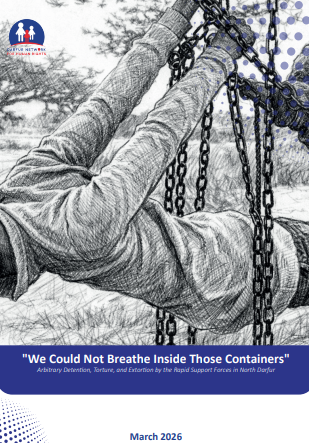
The Darfur Network for Human Rights today publishes “We Could Not Breathe Inside Those Containers” a report documenting arbitrary detention, torture, sexual violence, forced labor, and systematic extortion carried out by the Rapid Support Forces against civilians in North Darfur between May and December 2025. Based on secure remote interviews with 12 survivors and corroborated with satellite imagery, it is the most detailed account yet of what happened inside RSF detention facilities after El Fasher fell.
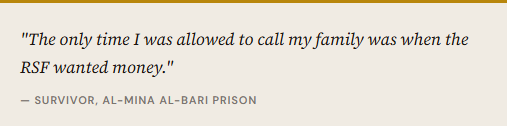
“We buried between fifteen and seventeen people every day.” Survivor, Al-Mina Al-Bari Prison, November 2025
Detained Without Charge. Tortured. Ransomed.
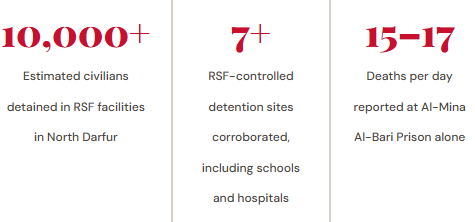
DNHR corroborated the existence of at least seven RSF-controlled detention sites across North Darfur including Al-Mina Al-Bari Prison, Shalla Detention Centre, and makeshift facilities repurposed from schools, hospitals, and abandoned buildings. An estimated 10,000 civilians were held across these sites, without charge, without legal representation, and without access to their families except when the RSF demanded ransom.
At Al-Mina Al-Bari, detainees were packed into metal shipping containers up to 100 people per container, in extreme heat, with no ventilation. People could not sit or move. Deaths were so frequent they became routine forced labor: each morning, young male detainees were selected to bury those who had died overnight.
Every single survivor interviewed by DNHR was subjected to torture, beatings with sticks, whips, metal rods, and gun butts; stress positions; and severe sexual violence including rape of female detainees and castration of male detainees. Detainees were systematically dehumanized with racial slurs, called “slaves” and targeted based on tribal identity. When one detainee revealed he was Nuba, RSF soldiers shot him on the spot.
Extortion as Policy
Ransom was not opportunistic, it was structured. Detainees were forced to log into their personal Facebook accounts on RSF phones, call their families, and negotiate their own release price in real time, with RSF soldiers participating in the call. Payments were processed through mobile banking platforms. Demands ranged from 8 to 15 million Sudanese pounds per person. Those whose families could not pay remained imprisoned or were put to work as forced labor.
Crimes Against Humanity
The violations documented; murder, enslavement, torture, rape, ethnic persecution, and enforced disappearance constitute crimes against humanity under international law, and breach Common Article 3 of the Geneva Conventions. The UN Security Council’s 2005 referral of Darfur to the International Criminal Court gives the ICC direct jurisdiction.
DNHR is calling on the RSF to immediately release all arbitrarily detained civilians and cease all torture and extortion; on the UN Security Council to enforce the arms embargo and impose targeted sanctions on named RSF commanders; on the ICC to prioritize investigations and issue arrest warrants; and on the African Union to deploy independent monitors to detention facilities.
About DNHR
The Darfur Network for Human Rights is an independent NGO monitoring and documenting violations across Darfur and Sudan, founded by Mohammed Adam Hassan. Interviews were conducted remotely via encrypted channels between October 2025 and January 2026.