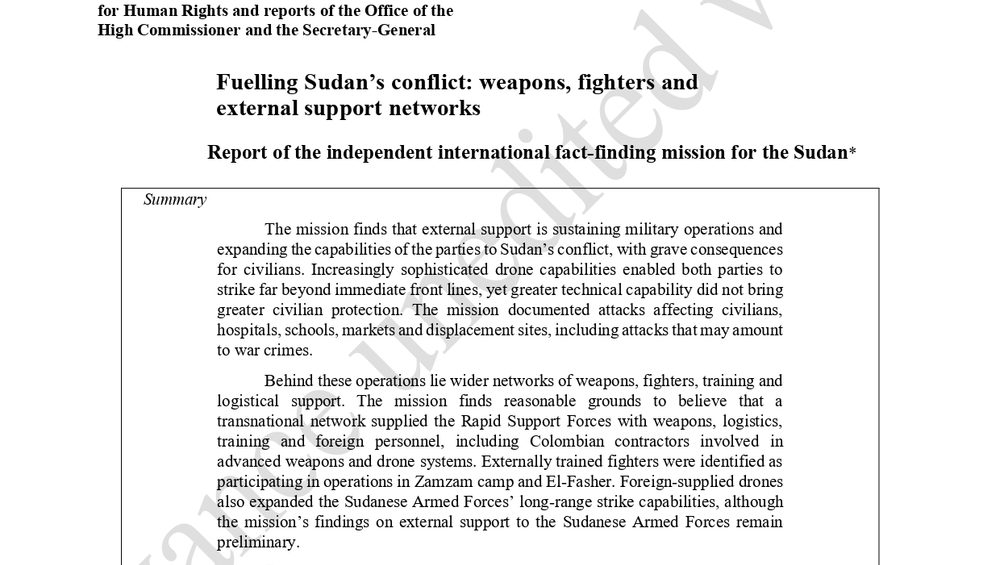
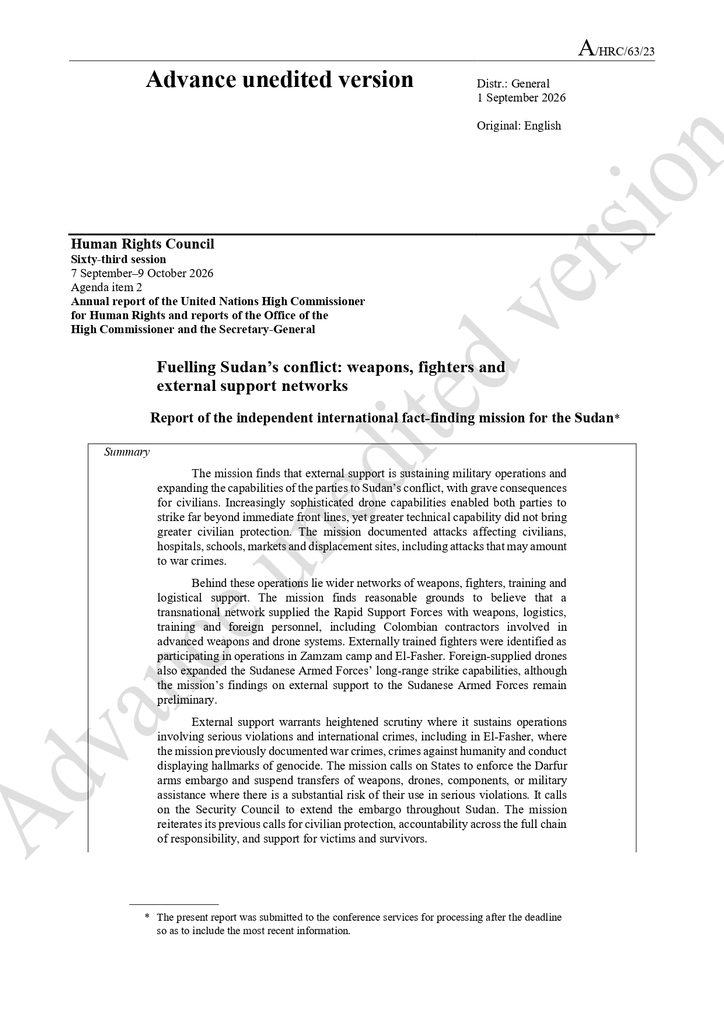
A new report by the UN Independent International Fact-Finding Mission for the Sudan, submitted to the Human Rights Council’s sixty-third session, finds that expanded drone capabilities have redefined the battlefield in Sudan. Attacks now extend far beyond front lines. The mission finds reasonable grounds to believe that both the Sudanese Armed Forces (SAF) and the Rapid Support Forces (RSF) committed serious violations of international humanitarian law through their drone operations, some amounting to war crimes.
How Drone Warfare Changed the Conflict
Greater technical capability did not bring greater civilian protection. Instead, expanded drone capabilities allowed both parties to strike hospitals, schools, markets, and displacement sites far from active fighting, eroding the protection that distance once offered civilians.
In El Obeid, repeated RSF drone attacks between May and July 2026 degraded the city’s electricity, fuel, and water infrastructure. This disrupted hospitals already struggling to sustain oxygen supplies and emergency surgery. In Kalogi, South Kordofan, successive strikes hit a kindergarten during a school ceremony, then struck responders, then a vehicle carrying casualties to hospital, killing 114 people, including around 60 children. In Kadugli, a drone struck a former IOM building sheltering displaced families, killing at least five children.
Comparable violations were attributed to the Sudanese Armed Forces, including strikes on Ad-Da’ein Teaching Hospital, which killed at least 70 people, a market in Abu Zaima, and Yabus market in Blue Nile, which killed at least 13 civilians. Further documented attacks hit a wedding in Kutum, a displacement camp in Zalingei, and a traditional court in Ghara al-Zawiya, North Darfur.
External Networks Sustaining the RSF
The report’s most significant finding concerns a transnational network the mission says has sustained the RSF’s military operations. Weapons, drones, foreign fighters, training, and logistical support reached the RSF through routes linking individuals and entities in the United Arab Emirates, Chad, southeastern Libya, and Puntland, Somalia, with Nyala Airport in South Darfur identified as a principal entry point.
The mission also documented the recruitment of an estimated 350 to 2,000 Colombian contractors, deployed to operate drone systems and train RSF fighters, including during the assault on El Fasher. Two individuals linked to this recruitment network were sanctioned by the UN Security Council in April 2026.
Meanwhile, the mission’s investigation into external support for the SAF is at an earlier stage. It has, however, already verified foreign-supplied Bayraktar Akıncı drones and Yiha III loitering munitions in strikes attributed to the army, including the Yabus market attack.
How States Responded
Chad denied knowledge of weapons transfers through its territory, though the mission found evidence of transit through Chadian border areas. Colombia acknowledged its nationals’ involvement and described new measures against mercenary activity. As a result, the mission found no evidence of Colombian state responsibility. The UAE, on the other hand, rejected all allegations, calling them a “false media campaign,” though the mission concluded that UAE-linked individuals and entities played a significant role in the network. Ethiopia, Libya, Somalia, and South Sudan did not substantively respond.
DNHR’s Position
DNHR welcomes this report as a rigorous and urgently needed accounting of how external actors are prolonging the atrocities documented across Darfur, Kordofan, and Blue Nile. Put simply, the technology and networks sustaining this war are not incidental to the violence, they are enabling it directly, including in places where the mission has found conduct bearing the hallmarks of genocide.
The Fact-Finding Mission’s mandate is due for renewal at this same session. Therefore, DNHR calls on the Human Rights Council to renew and strengthen the mandate, on the states named in this report to shut down the networks operating from their territories, and on the UN Security Council to extend the Darfur arms embargo to cover the whole of Sudan.