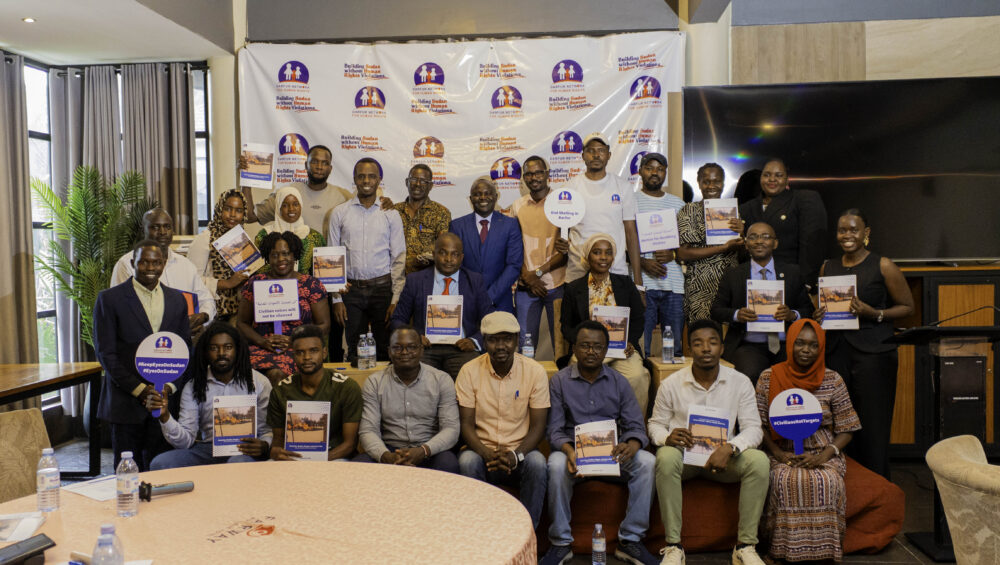
On 24 September 2025, the Darfur Network for Human Rights (DNHR) launched its new report,
“Every day Bombs, Hunger, and Loss of Life: Accounts of Forgotten Victims in North Darfur,” at the Fairway Boutique Hotel in Kampala, with global audiences joining via livestream.
The report documents indiscriminate shelling of markets, homes, hospitals, and IDP camps, alongside the use of starvation as a weapon of war. Drawing on survivor testimonies, it exposes deliberate tactics of civilian targeting that may amount to war crimes and crimes against humanity.
Event Highlights
The launch opened with a video presentation featuring survivor voices and an overview of DNHR’s findings.
The keynote speech delivered by Mr. Leon Lulema set the tone for the afternoon. He described the report not as “a record of violations,” but as a reckoning and a demand for accountability.
In his remarks, he called for a moment of silence to honor those killed: children buried in mass graves, mothers searching for their sons, aid workers slain in the line of duty.
Lulema traced Darfur’s suffering to decades of exclusion, militarized governance, and impunity, stressing that today’s war is a continuation of unresolved grievances. He underlined the legal breaches, including violations of the Geneva Conventions, the Rome Statute, and the African Charter, and pointed to starvation as a weapon of war.
“The people of North Darfur are not collateral,” he said. “They are survivors. They are witnesses. They are the moral center of this report.” His call to action urged regional and international bodies to enforce arms embargoes, secure humanitarian access, and reject proxy violence.
Panel Discussion: Voices from the Frontlines
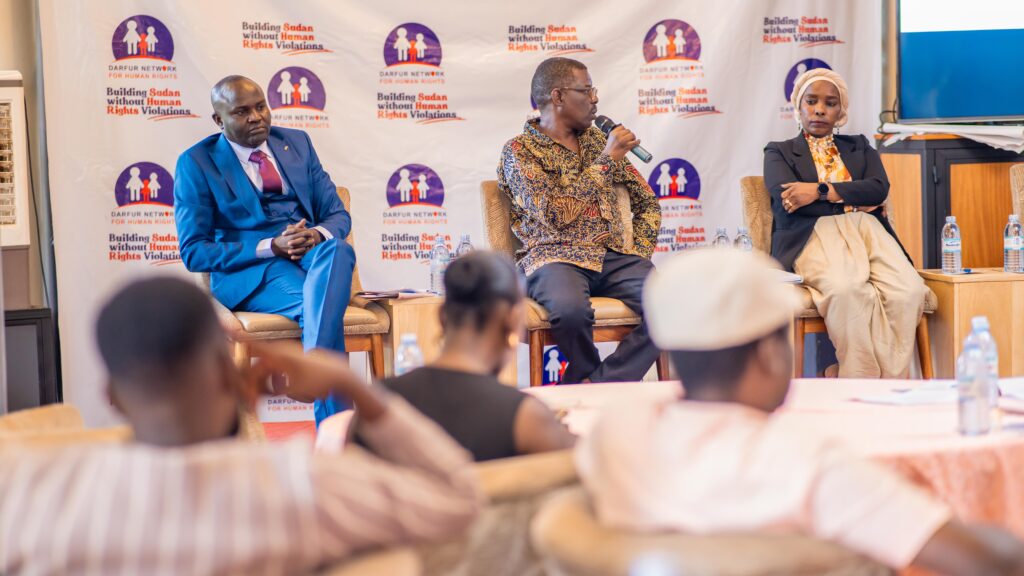
The panel, moderated by Mr. George Nalo, co-founder of Education in Crisis, brought together diverse perspectives:
- Mr. Mohammed Adam Hassan, DNHR’s Executive Director, reflected on the organization’s documentation of atrocities since 2014, emphasizing the responsibility of civil society to preserve evidence for future accountability.
- Mr. Mohammed Badawi, Monitoring and Documentation Director at the African Centre for Justice and Peace Studies, spoke on the legal dimensions of starvation and indiscriminate attacks, underscoring the need for stronger accountability mechanisms.
- Ms. Awatif Ishaq, journalist, human rights defender, and herself a survivor of Darfur’s violence, spoke of the layered impacts on women, children, and displaced families. Her testimony brought the human cost into sharp focus, reminding the audience that the report is not abstract, it carries the lived experiences of victims who entrusted DNHR with their voices.
International Solidarity: Amnesty International
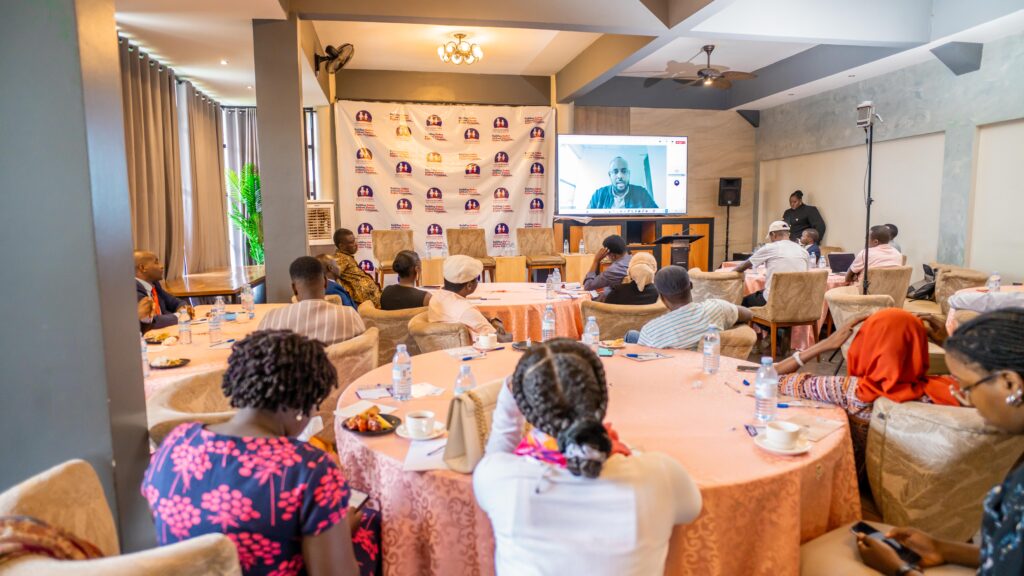
Joining virtually, Mr. Abdullahi Hassan from Amnesty International drew attention to ongoing human rights violations by both the Sudanese Armed Forces (SAF) and the Rapid Support Forces (RSF). He highlighted indiscriminate attacks, ethnic targeting, and sexual violence as tactics of war.
Abdullahi called for the establishment of an independent international mechanism to monitor and document violations, for the extension of the UN Human Rights Council’s mandate, and for the International Criminal Court’s jurisdiction to be strengthened in relation to Darfur. He also urged an expanded arms embargo and increased international humanitarian support.
A Call to Action
The findings of Every day Bombs, Hunger, and Loss of Life are clear: civilians in Darfur continue to face bombing, starvation, and displacement, while the world remains hesitant. DNHR urges regional and international actors to act decisively not with words, but with enforcement, access, and accountability.
🎥 Watch the livestream
📄 Read the full report → Everyday Bombs, Hunger and Loss of Life
#EyesOnSudan #KeepEyesOnDarfur.