On World Humanitarian Day, Sudan remains at the center of one of the world’s largest displacement crises. Escalating conflict and destructive seasonal flooding are compounding an already grave humanitarian situation. Disruptions to global supply chains through the Red Sea and Strait of Hormuz add further pressure to an already fragile response.
Conflict and Infrastructure Attacks Driving Displacement
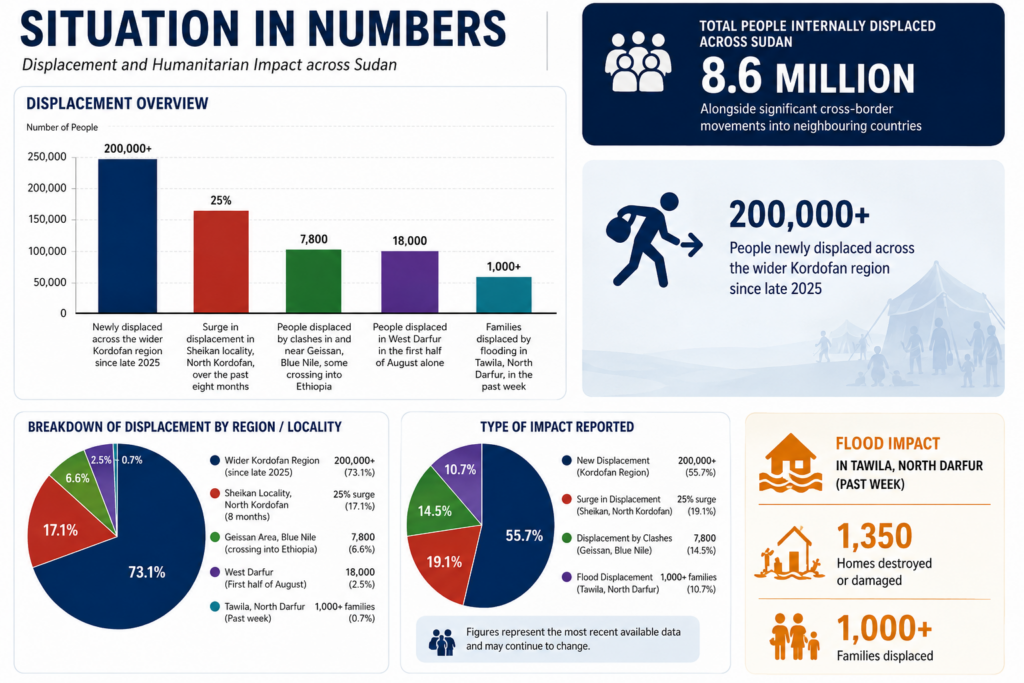
In North Kordofan, intensified fighting and drone strikes hit El Obeid’s main electrical transformer. This triggered prolonged power outages, disrupting water pumping, health facilities, and telecommunications across the city. The resulting displacement surge in Sheikan locality reflects a broader pattern across Kordofan, where more than 200,000 people have fled since late 2025.
In Blue Nile, clashes in and near Geissan displaced 7,800 people. Some crossed the border into Ethiopia in search of safety. Meanwhile, West Darfur saw nearly 18,000 people displaced in just the first two weeks of August. This shows how quickly conditions can deteriorate across multiple fronts at once.
Flooding Compounds an Already Fragile Situation
Heavy rainfall in Tawila, North Darfur, destroyed or damaged nearly 1,350 homes last week alone. This displaced more than 1,000 families. Additional flooding in Kabkabiya and Shangil Tobaya forced dozens more families into temporary shelters, layering a seasonal climate emergency on top of an active conflict.
Humanitarian Response Under Strain
Humanitarian organizations continue to scale up assistance despite these mounting challenges. Over the past 72 hours, aid agencies delivered 1,750 metric tonnes of humanitarian supplies. This included 17,750 hygiene kits and 850 tents, directly benefiting 110,750 people in areas of acute need. Agencies expect this reach to rise to over 400,000 people in the coming days.
However, funding for shelter interventions is declining sharply. This threatens the continuity of the response at precisely the moment displacement is accelerating.
DNHR Position
On this World Humanitarian Day, DNHR stands with the humanitarian workers and organizations delivering life-saving assistance under increasingly dangerous and constrained conditions across Sudan. The combination of active conflict, deliberate attacks on infrastructure like the El Obeid transformer strike, and worsening seasonal flooding reflects a crisis that is compounding faster than the response can keep pace with.
DNHR calls on the international community to close the funding gap threatening shelter and pipeline operations. DNHR also calls for unimpeded humanitarian access across all conflict-affected regions, and accountability for those responsible for attacks on civilian infrastructure that strip millions of Sudanese families of water, electricity, and healthcare.
About DNHR
The Darfur Network for Human Rights (DNHR) documents human rights violations in Darfur and across Sudan. DNHR advocates for accountability and civilian protection through engagement with UN and African human rights mechanisms.