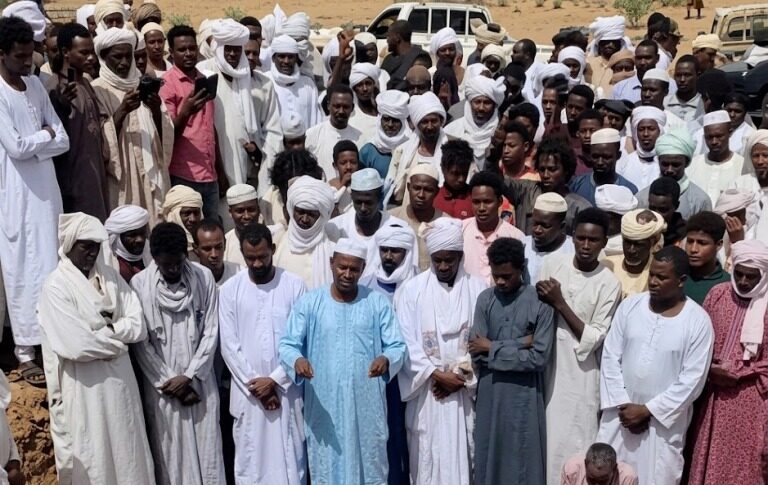
On Sunday, Sudanese army drones struck a traditional court in Garra al-Zawaya, a North Darfur village under Rapid Support Forces (RSF) control. Emergency Lawyers reported at least 35 people killed, while the RSF’s self-declared administration put the toll at 37 dead and 50 wounded. Among the dead were four tribal leaders and two RSF commanders, struck while sitting under a tree hearing local disputes.
Drone strikes and instability are not new to this region. North Darfur has faced sustained insecurity for years, and both the army and the RSF have relied heavily on drone warfare since well before this year. What stands out about Garra al-Zawaya is not the method, but the target and the timing.
A Civic Institution, Not a Frontline
Traditional courts in Darfur are not military sites. They are where tribal elders resolve land disputes and community grievances, often the only functioning civil institution left in areas otherwise shaped by war. This strike killed tribal leaders alongside RSF commanders, meaning the loss extends beyond combatants to local governance structures communities depend on.
The Timing
The strike came days after RSF commander Mohamed Hamdan Dagalo told his fighters, in a video message following the army’s recapture of the Khartoum–El Obeid highway, to consider themselves “unleashed.” El Obeid has faced intensifying drone attacks in recent weeks, prompting the UN to issue a “red alert” over what it describes as an unfolding catastrophe there, with fears of an RSF ground offensive. Read alongside that timeline, Garra al-Zawaya looks less like an isolated incident and more like part of the same intensifying exchange currently centered on North Kordofan.
DNHR Position
DNHR condemns the strike on Garra al-Zawaya’s traditional court in the strongest terms. The targeting of a civilian gathering, regardless of who else was present, raises serious concerns under the principles of distinction and proportionality in international humanitarian law. DNHR calls for an independent investigation into this strike, and for both the Sudanese army and the RSF to halt drone strikes on civilian and communal spaces. DNHR continues to warn that the current escalation around El Obeid and North Kordofan risks further atrocities against Darfuri civilians.
About DNHR
The Darfur Network for Human Rights (DNHR) documents human rights violations in Darfur and across Sudan, and advocates for accountability and civilian protection through engagement with UN and African human rights mechanisms.